
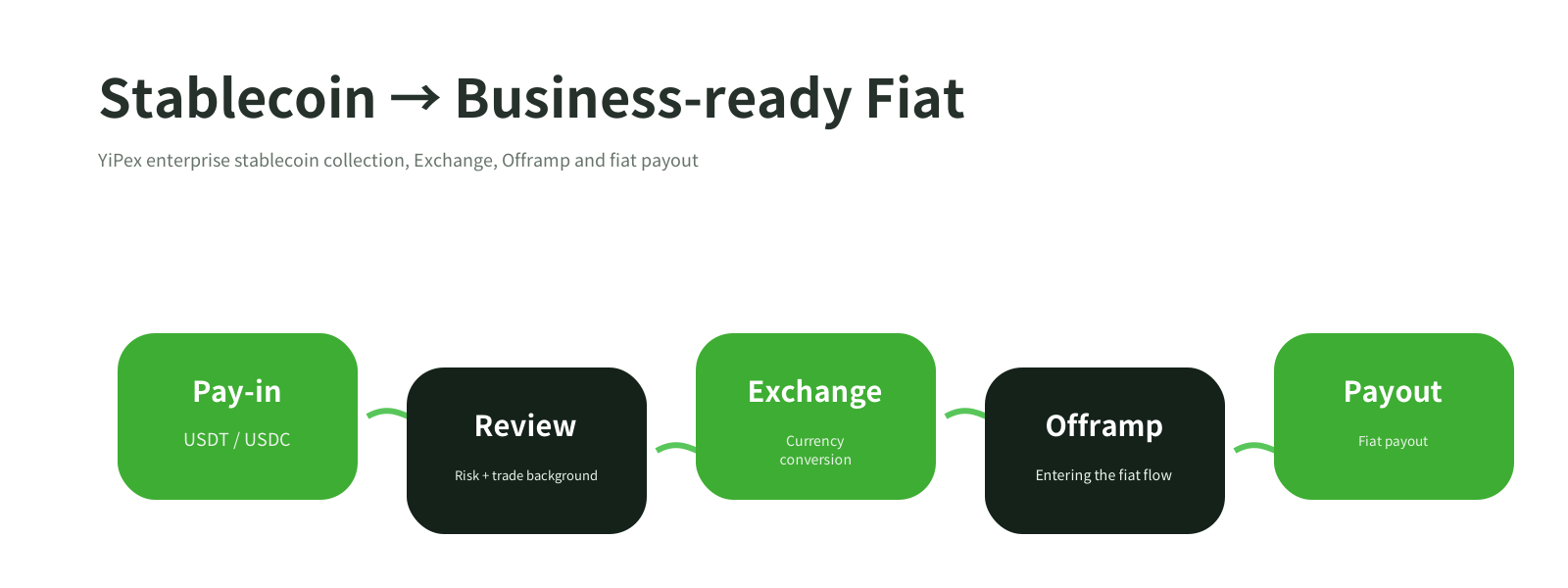
A business being able to receive USDT or USDC does not mean a cross-border commercial payment is finished. For an individual user, a higher wallet balance usually means "the money has arrived"; a business, however, is handling orders, contracts, receivables and payables, suppliers and financial records, so it still has to answer a series of operating questions: which customer the funds came from, which order they correspond to, whether the paying address carries risk, whether the stablecoins received need to be converted, and how they will finally be paid to a supplier, a partner or an overseas team.
So once stablecoins enter a real operating scenario, the business's focus shifts from "can we receive the coin" to "what do we do once we have received it". A typical enterprise stablecoin payment may go through collection identification, on-chain risk checks, trade-background review, currency conversion, digital-asset to fiat conversion and finally the fiat payout. YiPex's enterprise stablecoin payment infrastructure is built around exactly this fund chain: on the basis of an integrated digital-asset and fiat account across multiple chains, currencies and countries, it connects funds-processing actions that were previously scattered into a more continuous enterprise workflow.
1. Stablecoins changed cross-border value transfer, but enterprise payment still has a long way to go
A traditional cross-border payment is not simply subtracting from one account and adding to another. When the payer and the payee are in different countries, using different currencies and banking systems, funds may pass through the account-opening bank, correspondent banks, foreign exchange conversion, clearing networks and the receiving bank. Different institutions also have their own business hours, processing rules and review requirements, and all of this shows up in arrival time, fund availability, exchange rates, operating cost and uncertainty about payment status.
Stablecoins such as USDT and USDC provide another way to transfer value. Assets can move across borders over blockchain networks, and the transaction status can be queried from on-chain records. For some trade businesses this adds a more flexible path for how value moves from one country to another, and reduces the situations where fund transfer depends entirely on traditional bank account relationships.
But business activity has not migrated entirely on-chain because of that. Suppose a buyer in Latin America needs to source machinery and equipment from a Chinese supplier and both sides accept USDT as the payment medium: the buyer can complete the stablecoin payment on-chain. The supplier's operating expenses may still be denominated in USD, HKD or another fiat currency, and finance still has to know which customer the funds belong to, which order, what trade background, and who was ultimately paid.
So an on-chain record of a 100,000 USDT transaction only shows that an asset moved; for the business to complete a commercial collection, that asset has to be connected to the real transaction. Who paid, why they paid, which contract or order it corresponds to, whether it can enter downstream processing, what currency it needs to be converted into, and where it is finally paid — these questions together form part of the enterprise funds flow.
That is also why payment problems do not disappear once a business adopts stablecoins. What changes is how funds are transported; the business still has to connect on-chain assets with customers, orders, financial accounts, suppliers and fiat payment networks. Whether the business can use that money smoothly is often decided by exactly these connection points.
2. Once a USDT payment arrives, what else does the business have to handle?
From the business's point of view, the first thing after a stablecoin arrives is not immediate conversion but collection identification. If a company has one customer and receives one or two USDT payments a month, a finance team member can open the wallet, see the amount, and ask the business team who paid it. When the company serves dozens of customers at the same time, across multiple orders, multiple wallet addresses, different blockchains and a large number of transactions, that approach stops working very quickly.
On-chain records can tell a business that one address transferred an asset to another, but they do not inherently know which purchase order, which service contract or which customer that money corresponds to. Enterprise stablecoin collection therefore has to establish the correspondence between payer, currency, network, amount, order and customer. YiPex's current public product materials disclose multi-chain collection of USDT / USDC, and provide a dedicated collection app, two-way verification through institution codes, and on-chain transaction and address risk scanning such as KYT / KYA.
KYT (Know Your Transaction) addresses the identification of on-chain fund risk. The fact that blockchain transactions are publicly queryable does not mean a business can ignore the source of funds and address risk. The public materials also explicitly mention blocking high-risk addresses, which shows that enterprise stablecoin collection is not only about "seeing the money arrive" but about judging whether the asset can continue into the business process.
Beyond on-chain risk, the business also has to handle the trade background. Taking YiPex's publicly described goods-trade flow as an example, the two parties form a trade contract and a PI (proforma invoice), and as the business progresses logistics and other documents are produced. Once the funds arrive, the on-chain risk check and the trade-background review both enter the process, and the trade documents have to be matched against the fund records and archived. For the business, the point of this step is that an on-chain transfer can be explained as operating funds with a genuine business background, not merely a change of assets in a wallet.
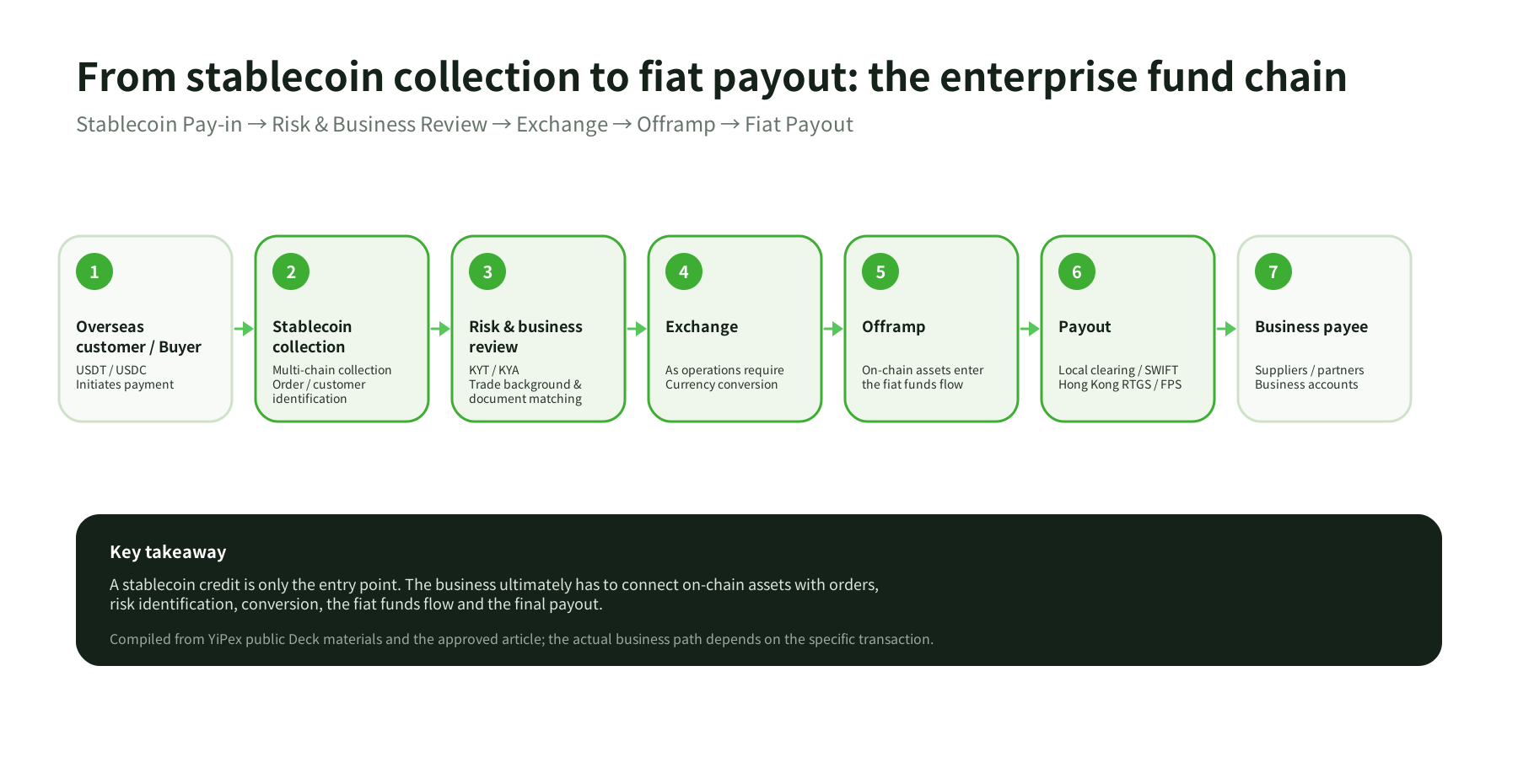
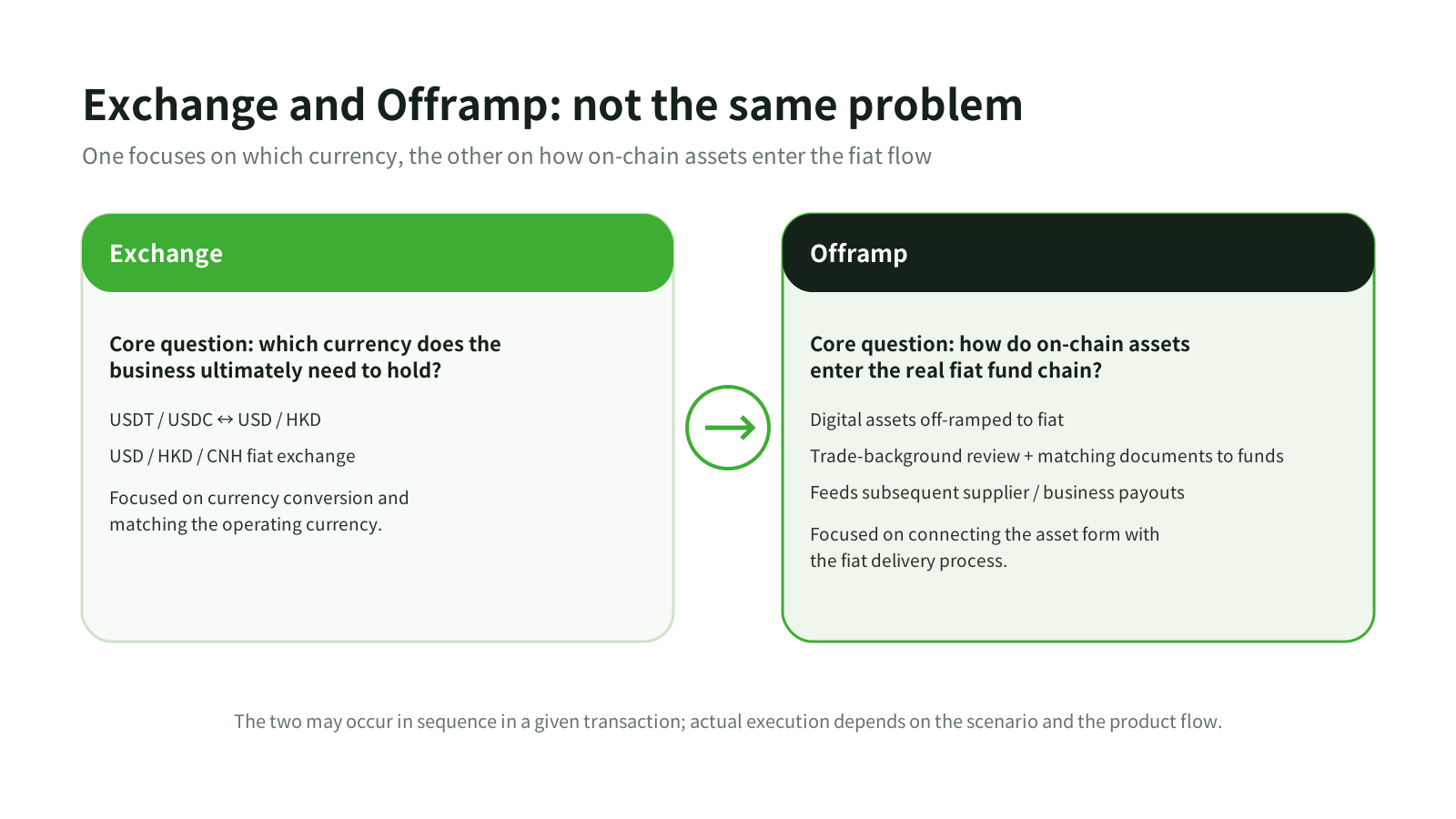
Only after collection identification and the relevant reviews are done does the business consider conversion according to how the funds will be used. Here it is necessary to distinguish Exchange from Offramp (digital asset to fiat) clearly.
Exchange mainly answers "which currency does the business ultimately need". A customer may pay USDT while the supplier needs USD; headquarters may manage funds in HKD; some business also involves fiat exchange between USD, HKD and CNH. The conversion capabilities listed in YiPex's public materials include conversion between USDT / USDC and USD / HKD, as well as fiat exchange scenarios such as USD / HKD / CNH.
Offramp is better understood from the angle of "how the asset enters the fiat payment process". The public product materials describe Offramp as the compliant off-ramp of digital assets into fiat currency, connected to trade-background review, matching of documents with funds and subsequent supplier remittance. In other words, Exchange emphasises which currency the funds are converted into, while Offramp emphasises how on-chain assets enter the real fiat funds chain. In a specific transaction the two may occur in sequence, but they should not be understood mechanically as two completely separate sets of actions; actual execution still depends on the transaction scenario and the product flow.
Once the funds have entered the fiat system, the business still has to complete the final Payout (fiat payment or disbursement). A business holding US dollars does not mean the supplier has received the goods payment. Different payees may be in Hong Kong, Southeast Asia, Latin America or the Middle East; some need US dollars, some need local currency; some payments are best made through the international banking network, while others need to enter a local clearing system.
The fiat payout capabilities disclosed in YiPex's current public materials include local collection and payout in 21+ countries, global SWIFT transfers, and fast payment channels such as Hong Kong RTGS / FPS. Here, too, two states need to be distinguished: the business has obtained fiat currency, and the fiat currency has reached the business payee. The first solves the asset form and currency question; the second also involves the receiving country, the receiving account, the payment network and the specific crediting method. A business may choose different routes in different transactions: some funds enter the target country through local clearing, some complete a cross-border transfer through SWIFT, and in Hong Kong scenarios payment networks such as RTGS / FPS can also be used. Which route to choose depends on the actual payee and the business requirement, rather than applying the same method to every transaction.
At this stage the basic chain of an enterprise stablecoin payment closes the loop: the customer pays in USDT / USDC, the business completes collection identification, risk and trade-background handling, then converts and off-ramps according to the actual use, and finally delivers the funds to the business payee through an appropriate fiat payment network. For the finance team, the most important value of this chain is not a few more payment terms, but that every change of asset can be explained against the same transaction.
3. Wallets, exchanges, OTC desks and banks all exist, so why does a business still need integrated funds processing?
A business can of course combine different tools itself. For a company with only a few cross-border payments a year, a single business country and a very small team, a combination of wallet + exchange / OTC + bank may already be enough. The business receives USDT, converts when it needs US dollars, and pays through a bank; when transaction volume is very low, the relationship between orders and funds can even be maintained in a spreadsheet.
Complexity usually appears with scale. Once a business goes from one overseas customer to twenty, from one country to five, and from a few transactions a month to dozens of funds-processing actions a day, the question is no longer whether the tools exist but how those tools work together.
The wallet holds the stablecoin balance, the conversion provider records the currency switch, the bank records the final fiat payment, the business system holds the orders, and the contracts and trade materials may sit in yet another system. Finance ends up having to reassemble all of this: which on-chain collection corresponds to which customer's which order, in which currency it was later converted, which account the fiat entered, how much of it has been paid to the supplier, whether the payment succeeded, and how much is still inside the company's funds system.
Each tool running correctly on its own does not automatically form a continuous fund record. As the business grows, it invests more people in reconciliation and exception handling, permissions and approvals have to be maintained across several systems, and a later audit has to look for evidence across platforms. When a payment goes wrong, the team may have to compare the wallet, the conversion records and the bank statement item by item before it can tell at which step the problem occurred.
This cost often does not appear directly in the fee of any single transaction, but it does appear in day-to-day operations. For example, the business team confirms that a customer has paid while finance is still looking for the corresponding order; the conversion is done but the payout team does not know whether those fiat funds can be disbursed; and when the final payee reports that nothing arrived, the on-chain transaction, the conversion record and the bank payment status all have to be traced again. The more transactions there are, the more this status-synchronisation work becomes a fixed labour cost and the more it can affect funding arrangements and customer communication.
So the value of integrated infrastructure does not come from the market lacking wallets or businesses being unable to find conversion services, but from reducing the coordination cost of running several funds tools together. Once countries, currencies, customers and internal roles multiply, organising collection, review, conversion, fiat conversion, payout and records into one traceable process is where enterprise-grade value begins to show.
4. How does YiPex turn scattered funds actions into a continuous process?
YiPex's current public positioning is enterprise stablecoin payment infrastructure for emerging-market trade, built on an integrated digital-asset and fiat account system across multiple chains, currencies and countries. The key to understanding this product is not to memorise how many features it has, but to see whether, as one payment moves through the system, the business keeps knowing what the money is, where it is now, and what has to happen next.
Once stablecoins come in, collection information is matched to orders, customers and business background; on-chain risk checks and trade review provide the basis for downstream processing; if the business needs another currency, the funds enter conversion; and when on-chain assets have to be used for real-world payment, digital-asset to fiat conversion and the final payout follow. The public Deck also presents a unified digital-asset and fiat account view as an important capability of the full-stack super account, which means a business can observe both types of assets and their conversion from one view instead of understanding every change as moving funds between platforms.
This continuity matters just as much for internal control. YiPex's published product architecture includes role-based permissions, approval workflows and audit logs. Applied to stablecoin collection and payout, these capabilities answer very concrete questions: who has the right to initiate an action, who approves it, which fund actions have to be recorded, and how it can be traced afterwards. Once enterprise funds involve several people, permissions and audit stop being add-on features and become part of day-to-day financial control.
If those controls remain scattered across several independent tools, the business has to manage not only the funds but also multiple sets of accounts, permissions and activity records. Putting key fund actions into a more continuous enterprise process makes it easier for internal teams to understand what state the funds are in and who is responsible for this step. It does not remove the company's own approval and management responsibilities, but it can reduce the information gaps between systems.
An integrated digital-asset and fiat setup also does not mean stablecoins and fiat currency become the same asset. It is closer to a unified treasury view: the business can see the relationship between stablecoin collection, conversion, fiat balances and the final payout, and connect those fund actions to actual orders and business processes. For a finance team, that relationship is closer to day-to-day treasury management than simply knowing how much USDT is left in a wallet.
This also explains why YiPex does not need to replace all of a company's existing banks, wallets or finance systems. Stablecoins, banking networks and local clearing systems in different countries can all exist within one transaction. What YiPex takes on is organising the part directly related to the company's cross-border funds processing more continuously, so the business spends less effort stitching fund status and business information together across isolated tools.
5. How does one real trade payment go from stablecoins to supplier payout?
YiPex's current public materials provide a goods trade case: a Latin American importer sources machinery and equipment from a Chinese supplier through a Hong Kong sourcing agent, and completes stablecoin collection, conversion and final payout through YiPex. The case has three clear business roles: the Latin American importer is the payer, the Hong Kong sourcing agent creates the corresponding trade order in YiPex, and the Chinese supplier is the business payee that ultimately has to receive the goods payment.
The transaction starts with the two parties agreeing the trade contract, the PI, the goods value and the payment terms. The sourcing agent creates the order in YiPex and fills in the goods, amount and logistics fields, and the payer confirms the order information through the app. The goods are then shipped, and the business side continues to upload the contract, PI and logistics documents. The information flow here matters: the funds do not exist separately from the transaction background but always have to stay matched to the order and the trade materials.
On the funds side, the payer initiates payment in USDT / USDC. Once the stablecoins arrive, the process moves into KYT on-chain scanning and trade-background review, and the relevant trade documents are matched against the fund records and archived. For the business, this step turns a stablecoin credit from one address into a payment made by a specific customer against a specific real trade, and it also gives the later conversion and payout a traceable business basis.
The case actually has two parallel but interlinked lines at the same time: one is the information flow, which keeps filling in the transaction background from the contract, the PI and order confirmation through to the logistics documents; the other is the fund flow, which advances from stablecoin payment and risk checks through to conversion and supplier payout. Only when the two lines correspond can finance answer why this money was received and why it was paid out. This is also the most easily overlooked difference between enterprise payment and a plain on-chain transfer.
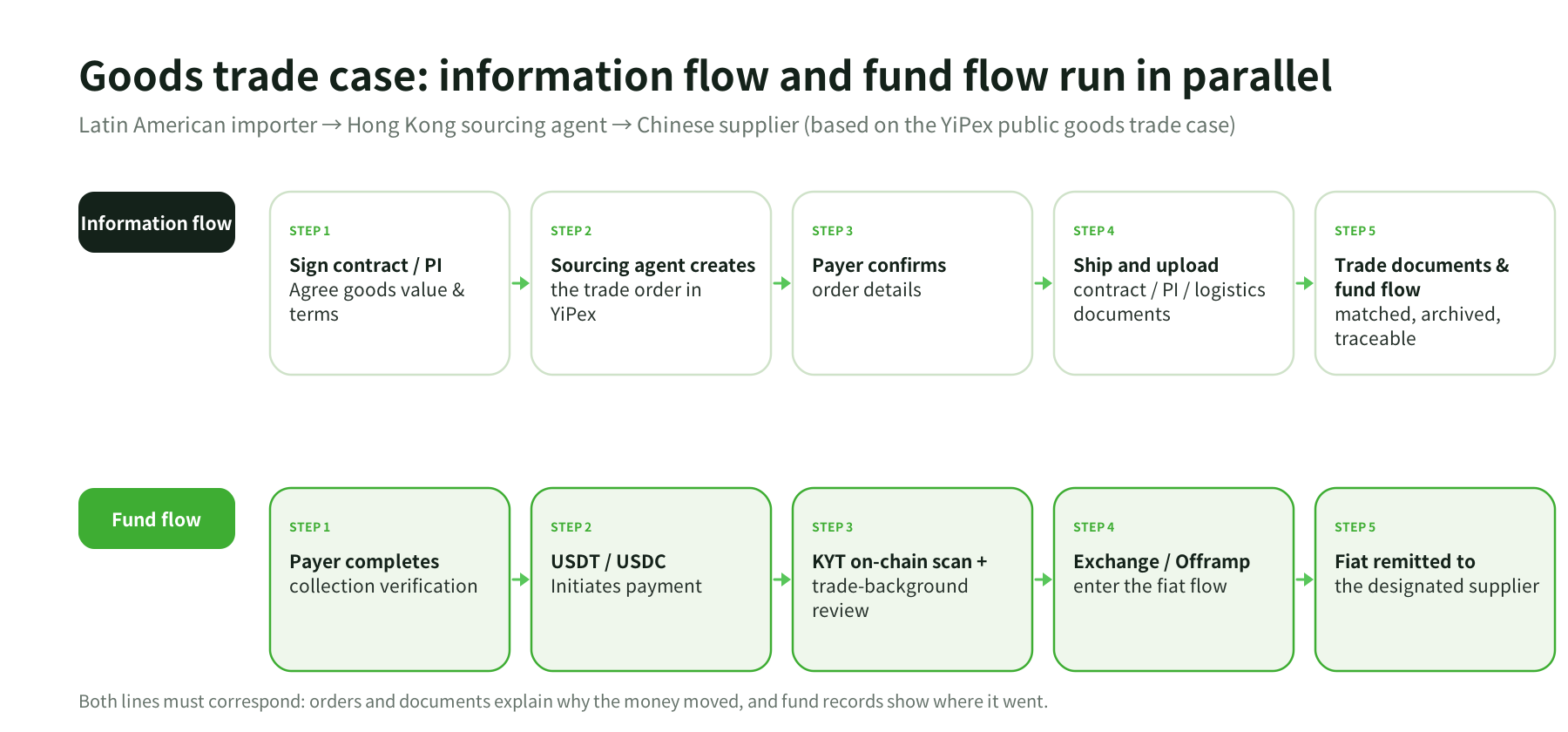
When the final supplier needs US dollars, the funds are converted according to the business requirement and enter the subsequent fiat payout process, ultimately remitted to the designated supplier. The same transaction therefore looks different to each role: the payer completes payment using the stablecoins they are used to, the supplier receives fiat currency that fits its operations, and the sourcing agent and the finance team can view the order, the trade materials, the on-chain funds and the final payout in one complete record.
This kind of process also shows why trade-background review cannot be treated as a compliance catchphrase. The business needs to prepare contracts, proforma invoices, logistics and other materials related to the real transaction in advance, and make sure the business information corresponds to the funds. Stablecoins increase the flexibility of transferring funds, but whether a business can smoothly complete the subsequent conversion and payout still depends on whether the business information is complete, whether the funds can be clearly explained and whether the relevant processes match.
The same logic extends to service trade. Another public case in the YiPex Deck is a Southeast Asian software outsourcing provider serving a Middle East client and collecting in stablecoins against project milestones. There is no goods logistics here, but there are service contracts, SOWs, deliverables, acceptance records and invoices. After the client pays USDT / USDC, the provider still has to convert the funds into the target fiat currency according to its operating needs and then pay local teams and suppliers.
Goods trade and service trade use different documents and different business processes, but the core funds-management questions are similar: the business needs to know which business the money came from, what processing it went through, and why and to whom it was finally paid. Stablecoins can be one efficient fund rail, and what the business has to manage is the connection between that rail and the real transaction.
6. Which businesses need this kind of stablecoin funds processing more?
Stablecoin payment infrastructure does not suit every business. If a company only receives one or two stablecoin payments occasionally, with fixed counterparties, and intends to hold digital assets for the long term, the existing wallet and conversion tools may already meet the need, and there is no reason to add complexity for the sake of a complete system.
The need is more obvious for a different kind of business: they have ongoing cross-border trade or service revenue, their customers have started using USDT / USDC; after receiving the funds they need to convert into USD, HKD or local currency and continue paying suppliers, partners, overseas teams or other business accounts. As transaction frequency rises, they also run into questions about matching orders with funds, identifying address risk, matching trade documents, who holds operating and approval permissions, and how finance completes reconciliation.
So when a business evaluates a stablecoin payment solution, it can start by mapping its own fund chain: which countries customers usually pay from, which assets it mainly receives, which fiat currency it ultimately needs, which countries the funds have to be paid to, and how many systems and manual steps one payment currently crosses from the customer initiating it to the supplier receiving it. The more complex the answers, the more the business needs to consider receiving stablecoins and managing the funds afterwards together.
For businesses already using or evaluating USDT / USDC for cross-border trade settlement, YiPex can further assess stablecoin collection, conversion and fiat payout arrangements based on the specific trade countries, collection and payout currencies, use of funds and target payout regions.
Stablecoins provide a new path for cross-border value transfer. For a business, what matters more is letting that path enter day-to-day operations: funds with a clear business source, a manageable conversion process, and the ability to reach the businesses and accounts that ultimately need to be paid.
FAQ
Why does a business still need conversion and Offramp after receiving USDT / USDC?
Because the payment asset a business receives and the currency it ultimately needs for operations may differ. Exchange solves the currency conversion question, while Offramp further connects on-chain stablecoin assets to the real fiat payment process so that subsequent business payments can be completed.
What is the difference between Exchange and Offramp?
Exchange focuses more on which currency the funds are converted into, for example conversion between USDT / USDC and USD / HKD; Offramp focuses more on how stablecoins become funds that can enter the real fiat funds chain, connected to trade-background review, document matching and the subsequent payout process.
Why can't a business just use a wallet, an exchange or an OTC desk?
It certainly can. For businesses with low transaction frequency, few business countries and simple processes, several independent tools may be enough. As customers, countries, currencies and transaction volumes grow, businesses are more likely to face reconciliation, permissions, fund-status tracking and multi-system coordination, and the value of integrated funds processing increases.
Which fiat payout methods does YiPex support?
According to the current public product materials, YiPex supports local collection and payout in 21+ countries, global SWIFT transfers, and payment routes such as Hong Kong RTGS / FPS. The specific scope of business support should be confirmed further according to the transaction countries, currencies and business scenario.
What type of business is better suited to stablecoin cross-border payment infrastructure?
Most typically: companies with ongoing cross-border trade or service revenue that already collect in USDT / USDC and also need fiat conversion, multi-country supplier payouts, trade-document matching and enterprise-grade treasury management.